VidRush YouTube Channel Playbook
The Complete Guide to Building Profitable YouTube Channels with AI
Chapter 1: Unit Economics & The Flywheel Effect
80% of your revenue comes from 20% of your videos
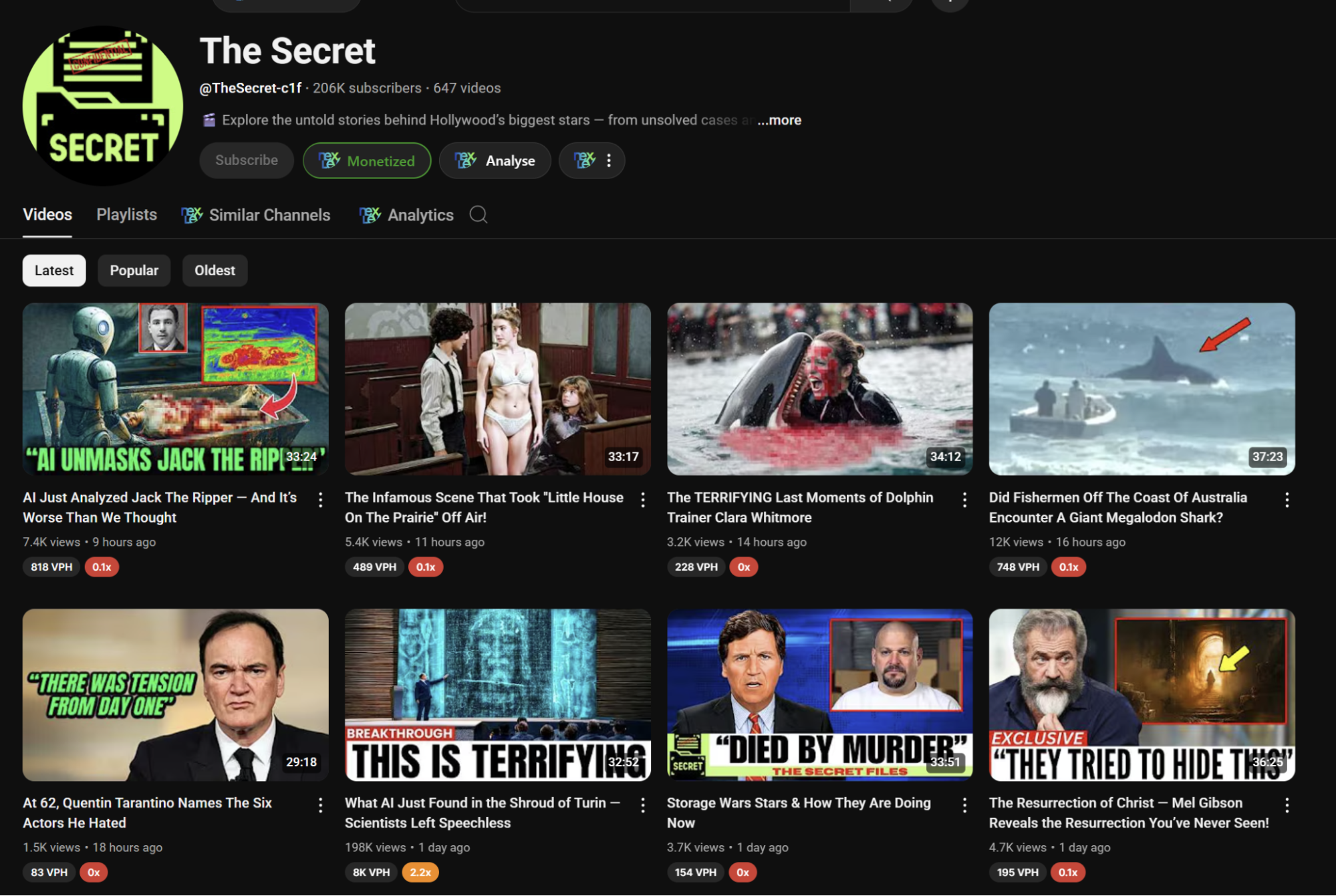
Looking at “The Secret” channel:
- 80% of their 647 videos probably generate just break-even revenue (1-5K views each)
- But 20% of their videos (the viral hits with 200K+ views) generate 80% of their total channel revenue and profit
This is why the VidRush strategy works so well - you’re not trying to make every video perfect. You’re playing the numbers game:
The 80/20 VidRush Strategy:
- Create high volume of “good enough” content (the 80% that breaks even)
- Let statistics work in your favor to generate the 20% of viral hits
- Use revenue from the 20% winners to fund even more volume
- The more volume you create, the more 20% winners you’ll statistically hit
This is why Noah emphasizes patience and volume over perfectionism. You can’t predict which videos will be in that golden 20%, so you need enough volume to ensure you hit those statistical winners that fund your entire operation and generate profit.
The Math That Actually Works
Your production cost with VidRush is $1.30-1.50 per minute, which means a 20-minute video costs you $20-30 to produce. With a typical RPM of $6-7, you break even at just 3,000-5,000 views per video. But here’s the key insight: don’t think about individual video performance. You need 30-100k views across every 10 videos to run a profitable channel.
The Flywheel Mechanics
One viral video that hits 50k-500k+ views generates enough revenue to fund approximately 260 more videos. Within those 260 videos, it’s statistically almost impossible that 2-3 more won’t go viral, funding another 500+ videos. This creates exponential growth where each viral hit funds even more content, creating a compound flywheel effect.
Three Channel Types
News/Current Events channels use pure narration plus B-roll format and can get traction in just 2-5 videos. Think political analysis, breaking news, or tariff discussions.
Evergreen documentaries focus on long-form storytelling content and usually take 10-20 videos for traction. These include historical events, true crime, and mystery content.
Discovery/niche content covers specialized subject matter and may need 100-200 videos before explosive growth, but offers the highest potential returns once the flywheel starts. Examples include regional mysteries, ancient discoveries, and folklore.
Real Risk Factors
There IS always risk of losing money, so don’t pretend otherwise. The biggest risks that kill channels are being too impatient and hopping between niches, executing too slowly by taking weeks instead of days, perfectionism over volume, and quitting right before the algorithm picks up your content.
Chapter 2: Niche Selection Strategy
Detailed Niche Selection Process
What you’re looking for is a niche where you can consistently get 20k-50k views to hit roughly 100k views per 10 videos on average, assuming a $5 RPM. Here’s exactly how to check:
Step 1: Check for Mass Flooding
Go to YouTube and search your niche keywords. Look at upload dates on the first 20 results. If you see 3+ new channels (created in last 30 days) uploading daily in your niche, skip it. The masses are flooding in and you’ll get lost in the noise.
Step 2: Identify Audience Fatigue
This is critical - if the same audience has seen the same videos and topics repeatedly, they stop clicking. Here’s how to spot it:
- Find the top 5 channels in your niche
- Look at their last 20 videos’ view counts
- If there’s a clear declining trend (example: videos went from 100k average to 30k average over past 3 months), that’s audience fatigue
- Check comments - if you see “not another one of these videos” or “this topic again?”, that’s a red flag
- Look at video topics - if the same 5-10 topics keep getting recycled by every channel, audiences are tired
Step 3: Confirm Recent Success Pattern
You need proof that 2-3 channels are hitting your target numbers recently:
- Find channels that have uploaded 20+ videos in the last 6 months
- Calculate their average views per 10 videos (take their last 30 videos, group into batches of 10, average each batch)
- You need to see at least 2-3 channels averaging 80k-120k views per 10 videos consistently
- Make sure this performance is recent (last 3-6 months), not from 2+ years ago when the niche was hot
Red Flags to Immediately Skip:
- New channels launching daily but all staying under 5k views per video
- Established channels showing 50%+ decline in average views over past 6 months
- Same topics being covered by 10+ channels in the past month
- Comments sections full of complaints about repetitive content
- No channels achieving 100k+ views per 10 videos in the past 6 months
Green Lights to Proceed:
- Only 1-2 new channels launching per week in the niche
- Top channels maintaining consistent view ranges over past 6 months
- Fresh angles and topics still being discovered and performing well
- Engaged comment sections asking for more content
- 2-3 channels clearly hitting 100k+ views per 10 videos recently
The 2-Day Rule
Your first upload should happen within 2 days maximum. Stop researching and start uploading. Speed of execution beats perfect research every time.
Winning Niche Examples
From Noah’s successful experience, news and current events work well, including political analysis, tariffs, economic policy breakdowns, and breaking news with available B-roll footage. Mystery and discovery content performs strongly, particularly regional mysteries from states like Missouri, Nevada, and Oregon, plus unsolved disappearances and historical cold cases. Documentary-style content succeeds with true crime stories, historical events with available footage, and biographical content.
What to Avoid
Skip oversaturated markets where new channels launch daily but all perform poorly. Avoid content requiring complex motion graphics that VidRush can’t handle, niches with limited available B-roll footage, and high copyright risk content.
Chapter 3: When to Keep Going vs When to Quit
Double Down Hard When You See Success
- If any single video hits 50-100k+ views, scale immediately and start multiple channels
- If one video hits above 20k views within your first 10 videos, you’ve found something that works
- If videos are consistently hitting 20-30k views after video 10, never stop before reaching 30 videos
Keep Going If You See Progress
Continue when one video gets above 1,000 views in your first 5 videos after 3 weeks - this is the bare minimum signal to keep going, not a reason to double down. Also keep going when average views across batches are trending upward, individual videos are showing breakthrough potential, or you’re seeing gradual audience growth and engagement.
When to Quit
Cut losses and pivot if you’ve uploaded 8 videos and nothing has reached 1,000 views. If you’ve uploaded 10-15 videos and nothing has reached 20k views, it’s time to quit this niche. Also quit if new competitors are flooding in daily with similar low performance.
The Patience Rule
If you’re seeing 20-30k view videos after video 10, never stop before video 30. If you’re seeing breakthrough videos over 50k, scale immediately. If you’re seeing consistent growth, be patient and keep uploading. If you’re seeing stagnation with no individual winners, cut losses and pivot.
Chapter 4: Your Competitive Advantage
Speed Is Everything
VidRush creates videos in under 1 hour versus the days or weeks traditional creators need. This speed advantage compounds because you can upload breaking news analysis the same day, beat larger channels to trending topics, capture early search traffic, test more thumbnail and title combinations, try more topics to find what works, and build larger content libraries faster than anyone else.
Volume Over Perfection
Your competitive advantage isn’t perfect videos. It’s good enough videos at scale. Focus on minimum viable quality standards like clear, understandable narration, relevant B-roll footage, basic but effective thumbnails, and accurate, fact-checked content. Then scale through efficient thumbnail creation processes, streamlined topic research, batch content creation, and systematic upload scheduling.
Work That Others Won’t Do
Use VidRush’s speed to dominate niches that others avoid because they’re “too much work, too little reward.” While everyone chases 500k+ view niches where all the competition goes, you can profitably dominate 20-80k view niches with your automated, low-cost production system.
Chapter 5: 30-Day Beginner Action Plan
Week 1: Foundation & Launch
Day 1: Niche Selection (2 hours maximum)
Find 1-3 niches using the validation framework. Pick the best one based on the three criteria: no mass flooding, no audience fatigue, and 2-3 channels hitting 100k views per 10 videos recently. Stop researching after 2 hours maximum.
Day 2: Pattern Analysis
Find the top 5 performing videos in your chosen niche from the last 6 months. Analyze the exact patterns: video length, thumbnail style, title format, topic angle, and content structure. Write down these patterns exactly as you see them. Identify the key points that made these outlier videos successful.
Days 3-7: Story Finding & Exact Replication
First, find your extrapolated stories by asking AI to analyze competitor transcripts. Take the competitor transcript and your new topic, then have AI generate an outline that follows the exact same structure. This ensures you’re covering uncovered topics but with proven formats.
Create your first 3-6 videos using the EXACT SAME FORMAT you identified. Don’t get creative. Copy the successful pattern precisely: same video length, same thumbnail style, same title structure, same topic approach. Upload your first 3-6 videos within the first week.
Week 2-3: Wait and Track Performance
Days 8-21: The Decision Period
After uploading your first 3-6 videos, you must WAIT for at least 2-3 weeks. You can keep uploading during this period but don’t upload too much - just be patient. During this waiting period, track if your original channel videos are performing well. If any hit 20-100k views, double down and upload consistently on that channel. If not, start testing another niche on a different channel while you wait for results from your first test.
Week 4: Scale or Expand
Days 22-30: Performance-Based Strategy
Give your videos 3-4 weeks minimum to be tested by YouTube’s algorithm. You can continue uploading but be patient - it takes a while these days to scale new channels. The trick during this period is to either start new niches or track if your original channel is doing well. If your channel hits 20-100k views consistently, double down and upload more content. When the channel becomes monetized and profitable, reinvest those profits into launching more channels.
Success Metrics to Track
- Week 1: Upload 3-6 videos using competitor transcript analysis to create same structure with new topics
- Week 2-3: Wait minimum 2-3 weeks. If videos hit 20-100k views, double down. If not, test new niche
- Week 4: Scale successful channels and reinvest profits into new channel launches once monetized
Chapter 6: The Horizontal Scaling Strategy
Building Multiple Revenue Streams
Instead of chasing one massive channel, build 2-4 smaller channels each generating $2-5k/month. This approach:
- Reduces termination risk
- Creates predictable income
- Allows for testing multiple niches simultaneously
- Builds compound growth across properties
The Digital Real Estate Mindset
Treat each channel as a small investment property rather than a lottery ticket. Focus on consistent $3k/month channels over volatile $10-15k spikes.
Chapter 7: The Extrapolation Method for Content Ideas
Finding Untapped Topics in Proven Formats
- Identify top-performing video patterns in your niche
- Extract the core concept (e.g., “snow machines”)
- Apply to parallel contexts (e.g., “desert machines”)
- Use AI to maintain exact script structure with new content
- Test variations systematically
The Transcript Replication Strategy
Take successful competitor transcripts, feed them to AI with your new topic, and have it generate scripts following the exact same structure but with fresh content. This ensures proven formats with unexplored topics.
Chapter 8: Market Evolution and Future-Proofing
The Declining Market Asymmetry
Information spreads instantly through tools like NextLev and Twitter. What used to take months for competitors to discover now happens in days. This means:
- Shorter profitable windows for trending content
- Need for faster execution
- Lower individual channel profits
- Higher importance of volume and efficiency
The Commodity Content Era
As AI makes content creation cheaper and easier, YouTube content becomes commoditized. Success comes from:
- Operating like a “day trader” capturing small, consistent wins
- Building systems for rapid deployment
- Accepting smaller margins but higher volume
- Focus on compound growth over home runs
Conclusion: Execute Fast, Be Patient, Scale Winners
Success with VidRush comes down to three principles: execute fast enough to test ideas quickly, be patient enough to let the flywheel effect work, and scale hard when you identify winners. The difference between success and failure isn’t talent or luck. It’s consistent execution and adapting based on real performance data, not assumptions.
Your VidRush journey starts with your first video uploaded within 48 hours. Make it good enough, upload it today, and start building your flywheel.